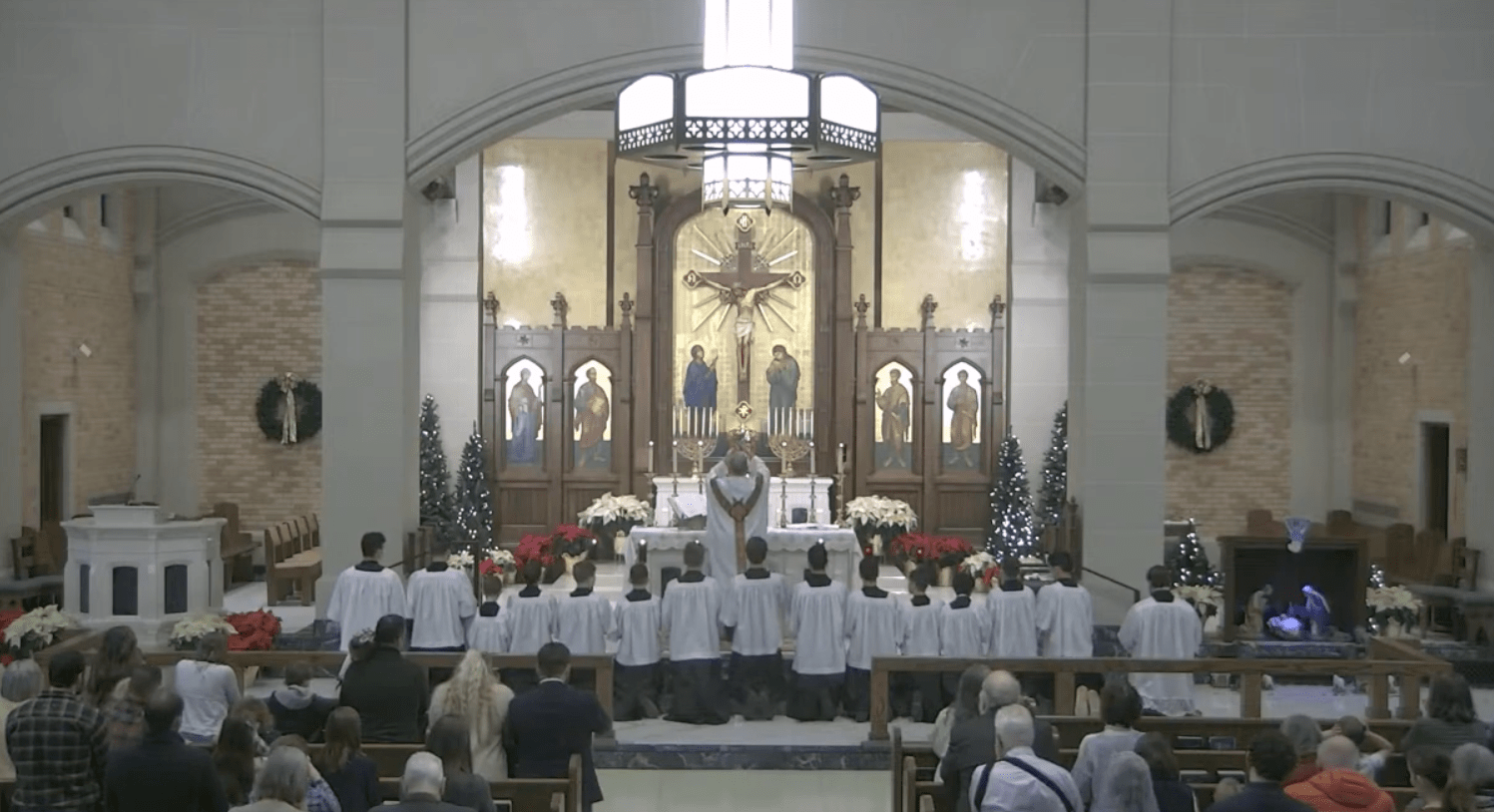
Recent events in Charlotte find me musing about what the future might hold when my own bishop tenders his mandatory letter of resignation on April 10, 2026, when he turns 75. Bishop Boyea has been a good shepherd for the Diocese of Lansing, and I thank God for him, his leadership, and his mission-minded focus on evangelization and Catholic education. I hope and pray that the Holy Father will allow him to continue serving as long as possible. But eventually (should the Lord tarry!) his successor will be named.
That decision is the Holy Father’s and his advisors, guided by the Holy Spirit. With all members of the Diocese of Lansing, I am praying for a good shepherd with the heart of the Good Shepherd who has administrative gifts and loves his people and his co-laborers, lay and clergy alike.
There are many good and faithful priests whom the Lord could call to serve here. I will welcome that bishop when he comes, and respect and obey him, as I promised I would when I was ordained in 2005.
During my time in the Diocese of Lansing, I served as Superintendent of Schools for six years (2009-2015). I served as a member of a strategic planning committee with Chancery officials, brother priests and deacons, as well as members of the lay faithful. Today, I am a pastor, Dean of the Lansing Deanery, and member of the Presbyteral Council and College of Consultors. All of that to say I know the challenges and difficulties of parish and diocesan life.
A Noble Task
St. Paul tells Timothy, “whoever aspires to the office of bishop desires a noble task” (1 Tim. 3:1). Today, in these times of skepticism about institutions, perhaps especially the Church, the task, though noble, is often tedious and thankless too. Perhaps that’s why 30% of priests asked to become bishops turn down the request. I thank Bishop Boyea for saying “yes.” And I am praying for the priest (or bishop) who will be named the Sixth Bishop of Lansing. In whatever way I can, I will support him.
I hope and pray that whomever succeeds Bishop Boyea will take time to get to know his priests and the history of the Diocese of Lansing, in order to prayerfully and effectively guide us forward, with an eye to the welfare of the flock. The Chancery staff are performing a diocesan-wide self-study that will assist the next bishop when he comes. I’m grateful for the bishop and his team’s foresight.
Bishops and the Liturgy
Given my recent post about the actions of Bishop Martin of Charlotte, some have asked me what I would do if the next Bishop of Lansing were to one day ban the use of the altar rail or stipulate that ad orientem celebration of the Novus Ordo was forbidden. This is not an idle question. Bishops and Archbishops have done so.
Primarily because I don’t believe the Church gives (arch)bishops authority to forbid what the Universal Church allows, I would appeal to my bishop, based on Church documents, to ask for reconsideration of the particular law in question. If that failed, I would appeal to the Dicastery for Divine Worship and the Discipline of the Sacraments to ask for clarification on the question. In the meantime, I would honor the bishop’s wishes until the matter was resolved.
Chief Liturgist . . . with Care
In 2004, Francis Cardinal Arinze, Prefect of the Congregation for Divine Worship and the Discipline of the Sacraments, in response to concerns about liturgical abuses following Vatican II, issued the instruction Redemptionis Sacramentum about the celebration of the Most Holy Eucharist. In the document, we read that “the diocesan Bishop, the first steward of the mysteries of God in the particular Church entrusted to him, is the moderator, promoter and guardian of her whole liturgical life” (RS 19). As steward, the local ordinary serves the Church and her liturgical life.
Because I believe that praying the Mass ad orientem and distributing communion at altar rails is entirely consistent with Sacrasanctum Concilium, I’m grateful that this document exhorts bishops strongly regarding how any liturgical norms should be developed, cautioning against unnecessary denials of freedoms foreseen by the Church.
[21.] It pertains to the diocesan Bishop, then, “within the limits of his competence, to set forth liturgical norms in his Diocese, by which all are bound”. [45] Still, the Bishop must take care not to allow the removal of that liberty foreseen by the norms of the liturgical books so that the celebration may be adapted in an intelligent manner to the Church building, or to the group of the faithful who are present, or to particular pastoral circumstances in such a way that the universal sacred rite is truly accommodated to human understanding. [46] (Emphasis Added.)
Ad Orientem celebration of the Novus Ordo Mass is certainly contemplated by the General Instruction of the Roman Missal. Were it not, there would be no reason for the repeated use of the adverbial phrase “facing the people” in the GIRM (124, 146, 154, 157, 165, and 185). Clearly, then, ad orientem celebration of the Novus Ordo is a liberty that the Church foresees. Given that fact, and the Instruction Redemptionis Sacramantum, I cannot believe that, if challenged, the DDW would uphold a particular law banning (or requiring dispensation to celebrate) Mass ad orientem. (Fr. Zuhlsdorf offers a thorough review of the ad orientem question and the GIRM on his blog.)
Bans on the use of kneelers or altar rails for public Masses may well be within a bishop’s competence. But as I mentioned in my earlier post, I think of kneelers and altar rails as a practical help to those who individually discern they wish to kneel to receive communion. Kneeling for the reception of communion is certainly a “liberty foreseen by the norms of the liturgical books,” so why ban the use of altar rails and kneelers? It seems heartless to me.
Caring
The strong exhortation that bishops “must take care not to allow the removal of that liberty foreseen by the norms of the liturgical books . . .” is very heartening to me. It reveals that the Church understands that matters liturgical have been and will be contested, and that the Church, if it “sides” with anyone, would seem to side with those who are in the minority, who seek to make use of liberties, such as kneeling for reception of communion, receiving communion on the tongue, and/or celebrating Mass ad orientem. It’s as if the Church wants to ensure we continue to allow practices that comport with the long liturgical tradition we have as Catholics. That’s good news and reason for hope, whomever my next bishop might be.
I just hope he will take care to take care of both the liturgy and the faithful.
 COME WHAT MAY
Bless me, Father, for I have sinned . . . i.e., if envy is a sin . . . for I’m envious of your flock for the beauty of the liturgical celebrations at the Church of the Resurrection. I’ve been away from the Lansing area for a few years but wistfully remember my occasional visits to COR. “Ah,” I often remarked, “that’s the way Eucharist is meant to be celebrated!” And now to see the recent enhancements of the sanctuary . . . Wonderful!
That said, Father, “Thinking Ahead” certainly sounds ominous. I hope and pray your apprehension about “what may come” never does. Your cautionary words smack of our Lord’s encouragement of his disciples at the Last Supper immediately before they wandered to the Garden of Gethsemani, singing hymns and prayers along the way. There, of course, Jesus prayed to be spared the cup of suffering set before him, but resolved to fulfill his Father’s will. Here, too, you seem to be preparing your flock for the possibility of “The Hour of Testing” described by Fr. Donald Haggerty in his recent book by the same title. Sobering thoughts, to be sure, but our Lord’s call to take up our cross and follow is not meant to be taken lightly, is it?
LikeLike
Thanks, Paul. It’s providential that you referenced Fr. Haggerty’s new book. I ordered it a few days ago, and just receive my copy this morning. We are in very interesting times. I’ll be prayerfully reading it, and contemplating how I am called to shepherd my flock. Do stop by to see the church in person when you’re in town. We’ll soon have two more icons, one of St. Gabriel and one of St. Raphael. They will complement our statue of St. Michael. The archangels are guiding our ministry of preaching, healing, and waging the spiritual battle. Come, Holy Spirit!
LikeLike
I’m with you father of course. I have always missed kneeling when receiving communion. I will be reading your blog also.
LikeLike